
AI + Home Care: Medicine's Next Big Shift
How smart technology is reshaping patient care (and why it matters now)


|
Welcome to Care & Connection Chronicle!
This week’s issue explores the strategic shift from patient acquisition to retention—and how AI, innovative care models, and proactive communication are reshaping sustainable practice growth in 2026.
What’s in this issue:
- 🎯 Why patient retention has become the most critical revenue driver for sustainable practice growth
- 🤖 How AI is saving physicians 39% of documentation time while preserving clinical nuance
- 💡 Alternative revenue streams healthcare leaders predict will define survival by 2030
- 🏠 Hospital-at-Home programs that improve satisfaction while optimizing facility utilization
- 🛡️ Crisis management lessons when leadership controversies threaten practice reputation
💡 Quote of the Day
“AI excels at speed but struggles with nuance—clinical listening skills remain irreplaceable in building the patient trust that drives retention.”
— Ontario Medical Association AI Resource Centre
📰 Latest News
🔗 Stopping Patient Attrition Before it Starts: A Proactive Approach to Healthcare Marketing (6 minute read)

Healthcare providers are fundamentally shifting focus from patient acquisition to retention—a more sustainable revenue driver that protects the expensive investment of acquired trust. The critical insight: dissatisfied patients quietly leave before openly complaining, with attrition occurring at predictable moments throughout the care journey.
Key Points:
- Attrition happens at four critical touchpoints: scheduling difficulties, rushed clinical visits, poor follow-up communication, and billing surprises
- HIPAA-compliant, personalized marketing communications at strategic intervals keep patients engaged in preventive care and reduce emergency department visits
- Retention improves lifetime patient value and stabilizes quality metrics more effectively than continuous acquisition efforts
Why it matters: Once patient acquisition reaches its limit, retaining engaged patients becomes the foundation for sustainable growth. This comprehensive framework identifies exactly where patients disengage and provides actionable communication strategies to intervene before attrition occurs—transforming retention from reactive damage control to proactive relationship management.
🔗 Artificial Intelligence in Medicine: Resource Centre (6 minute read)

The Ontario Medical Association has launched a comprehensive AI Resource Centre to help physicians navigate rapid technological transformation while maintaining the patient-centered care that drives loyalty. Key findings reveal AI’s potential to save 39% of medical charting time and achieve 93% accuracy in clinical predictions, but experts emphasize that technology must enhance—not replace—the human connection.
Key Points:
- AI scribes and clinical applications deliver measurable efficiency gains: 39% time savings in documentation and 93% accuracy in diagnostic predictions
- The resource centre provides practical guidance on implementation, curated innovations, and thought leadership to ensure physicians lead AI integration
- Success requires balancing speed benefits with irreplaceable clinical listening skills that build patient trust
Why it matters: AI represents the primary tool for operational efficiency in 2026, but only when implemented strategically to preserve care quality. This resource helps practices adopt AI scribes and clinical applications that free up physician time for the nuanced patient interactions that drive retention—proving technology and human connection aren’t competing priorities but complementary strategies.
🔗 Healthcare C-Suites Dive into Alternative Revenue Streams (31 minute read)
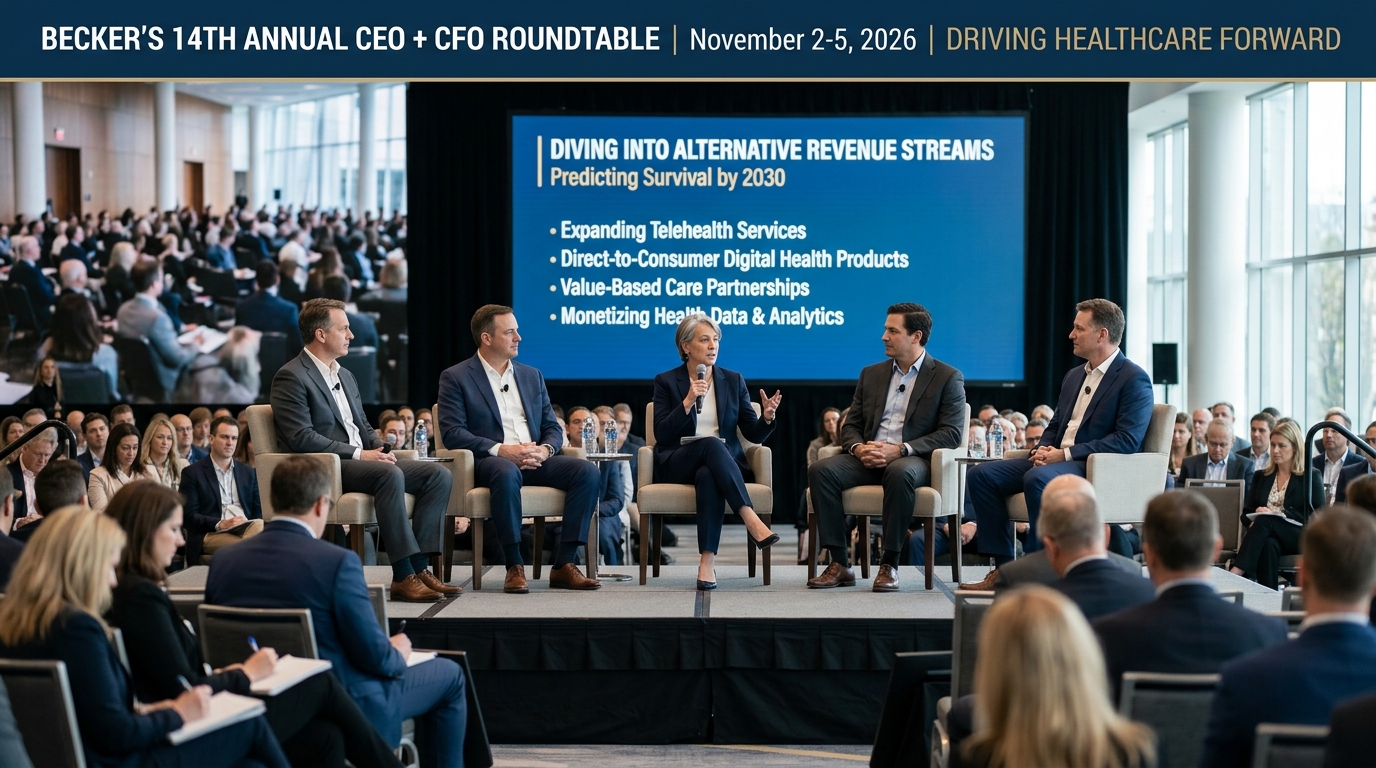
Healthcare leaders at Becker’s 14th Annual CEO + CFO Roundtable shared their predictions for alternative revenue streams that will define survival by 2030. The consensus: operational transformation beyond volume-based models is no longer optional, with success requiring diversification through AI-enabled care, risk-based models, workforce development, specialty pharmacy expansion, and employer-contracted services.
Key Points:
- Eight critical revenue streams emerged: AI-enabled care partnerships, risk-based care models for rural hospitals, workforce development as core revenue driver, specialty pharmacy and retail expansion, medical space leasing, joint ventures in post-acute care, employer-contracted models, and upstream care delivery
- Success requires focus on quality, value, population health management, and capturing existing demand through improved access and scheduling
- Leaders emphasize that technology and innovation enable diversification while maintaining patient-centered care
Why it matters: This strategic roadmap for 2026-2030 shows how technology adoption and innovative business models work together to diversify revenue beyond traditional volume-based care. The insights provide practice owners with concrete strategies—from tech partnerships to value-based contracts—that align financial sustainability with improved patient outcomes and engagement.
🔥 Trending
-
Hospital-at-Home Programs: Tampa General’s innovative model brings inpatient-level care to patients’ residences, combining twice-daily nursing visits with 24/7 remote monitoring—improving satisfaction while optimizing facility utilization
-
3D Medical Imaging for Patient Communication: Eonis Vision’s glasses-free 3D technology converts CT/MRI scans into interactive visualizations instantly, addressing the critical gap where patients struggle to understand flat 2D images
-
Healthcare Technology Sector Performance: Seven healthcare tech firms collectively beat Q4 2025 revenue expectations by 1.8%, with Hims & Hers reaching 2.51 million subscribers and Privia Health supporting over 4,300 providers through value-based care platforms
-
AI Design Tools for Marketing: Claude Design enables practices to create professional marketing collateral and patient education materials through natural language prompts—no design expertise required
⚡ Quick Hits
🎯 Crisis Management Lessons from Trusted Care Home Health
An El Centro home health agency is winding down operations despite claiming full regulatory compliance after its CFO’s arrest in a $261 million fraud investigation. The case demonstrates how leadership controversies can devastate patient trust and operational continuity even when the practice itself maintains compliance—highlighting the urgent need for crisis communication protocols. (Read more)
🎯 Patient Safety Protocols for High-Risk Procedures
A pediatric dental fatality involving Treacher Collins syndrome underscores the critical importance of comprehensive pre-procedure risk assessment. Experts emphasize that providers must recognize genetic conditions as serious risk factors requiring hospital settings with extensive backup support—a broader lesson in patient safety protocols for any high-risk procedures. (Read more)
🎯 Community Partnership Models for Brand Building
City of Hope’s $20 million Spirit of Life campaign demonstrates how corporate philanthropy and community partnerships can accelerate regional expansion and dramatically increase healthcare organization visibility. While the scale differs from typical practices, the model shows how business leaders increasingly view healthcare philanthropy as both social responsibility and community investment. (Read more)
🎓 Industry Insight
The Retention-Technology-Revenue Connection: Building Sustainable Practice Growth
The strategic narrative emerging from 2026 healthcare trends is clear: sustainable practice growth requires a three-part foundation. First, prioritize patient retention over acquisition by implementing proactive communication at the four critical attrition points—scheduling, clinical visits, follow-up, and billing. Retention protects your expensive investment in patient trust and delivers higher lifetime value than continuously chasing new patients.
Second, adopt AI and technology strategically to optimize operations while preserving the human connection that drives loyalty. AI scribes can save 39% of documentation time, but only when that reclaimed time is reinvested in the nuanced patient interactions that build trust. Similarly, 3D imaging technology and Hospital-at-Home programs demonstrate how innovation can simultaneously improve patient understanding, reduce anxiety, and enhance satisfaction—all retention drivers.
Third, use technology and innovation to enable alternative revenue streams that diversify beyond volume-based models. Whether through employer contracts, specialty services, population health management, or improved access through better scheduling systems, these strategies align financial sustainability with improved patient outcomes. The practices that thrive by 2030 will be those that master this connection: retain patients through better communication and technology, optimize operations with AI, diversify revenue streams, and protect practice reputation through crisis preparedness.
❓ Question of the Day
Which alternative revenue stream interests you most for your practice?
- A) AI-enabled care and technology partnerships
- B) Specialty pharmacy or retail expansion
- C) Employer-contracted or value-based care models
- D) Home-based or upstream care delivery
👋 Wrap Up
This week’s insights reveal a fundamental shift in healthcare business strategy: the practices that will thrive by 2030 are those building sustainable growth through patient retention, strategic technology adoption, and revenue diversification. From identifying the four critical attrition moments to implementing AI tools that preserve clinical nuance, from exploring Hospital-at-Home models to preparing crisis communication protocols—each strategy reinforces the others.
The message from healthcare leaders is consistent: success requires balancing operational efficiency with patient-centered care, leveraging technology to enhance rather than replace human connection, and diversifying revenue streams while maintaining quality. As you implement these strategies in your practice, remember that retention isn’t just about keeping patients—it’s about building relationships that create sustainable value for both your patients and your practice.
To your continued success,
Care Connection Editor
📊 How did you like today’s email?
Enjoyed this issue?
Subscribe to get Care & Connection Chronicle delivered to your inbox every week.
Join 39 other subscribers • Free forever